

One of the most commonly used components to locate bearings is the adapter sleeve. It locates bearings with a tapered bore to a cylindrical seat like the way they can be used on plain shafts or stepped shafts.
The adapter sleeves are easy to install and do not need an extra location on the shaft. When it is used on plain shafts, the adapter sleeves bearing can be located at any position on the shaft. When they are used on stepped shafts along with an L-shaped spacer ring, the bearing is positioned axially and hence it can mount and dismount easily.
Adapter sleeves are mainly used in printing, machinery, papermaking, aerospace, chemical, petroleum, coal, automotive, steel industry, engineering machinery, cement industry, mining industry, and other industries.
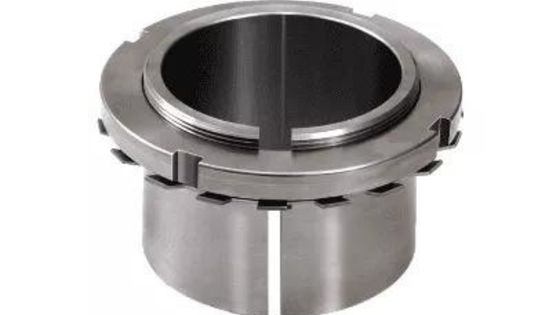
The various functions of adapter sleeves are:
Adapter sleeves are components to facilitate mounting of bearings using a tapered bore like Self-Aligning ball Bearings, Taper Roller Bearings, Cylindrical Roller Bearings, and Spherical Roller Bearings, on stepped or plain shafts.
When it is on a smooth plain shaft, the bearing can be situated at any position on the shaft. When it is on a stepped shaft along with an L-shaped spacer ring, the bearing is in the axial position.
Adapter sleeves can mount and dismount bearings quickly.
The adapter sleeve is a trusted machine element and the most tried one. It is made up of a tapered sleeve, locking plate, and a grooved nut. The common standards for adapter sleeves are DIN 5415, which is allocation of nut, adapter sleeve, and locking plate, DIN 981, which is locking plate, and DIN 5406, which is a counter nut.
This attachment type is appropriate for higher speeds where greater evenness is required. It is best for reversing various operations. The requirements made on the shaft adapter sleeves are less demanding than the cylindrical adapter sleeves bearing. The steel used here must have a minimum material strength to withstand.
The adapter sleeves bearing has three rules:
- Always measure the bearings starting in the North area.
- Always mark the answers using three-figure bearings.
- Always draw the bearings and measure them clockwise.
Adapter sleeves impact the adapter sleeves bearing slackness adjustment when the inner race is widened. Hence, the manufacturer specifies the tightening torques that must be heeded in case of any emergency.
Also, there must be a strong observation of the right assembly order. The bearing unit housing may be mounted once the adapter sleeve is fixed in its place, or else, there could be an axial tension with an extreme bearing load.
The standard adapter sleeve assortment includes:
- Adapter sleeves for metric shafts with metric bore and inch bore
- Inch adapter sleeves
The larger size for adapters comes with a bore diameter, that is d1 ≥ 1 060 mm. The sleeves are slit and are given with a locking device and lock nut. Smaller sizes of adapter sleeves have a lock washer and a nut. Larger sizes of adapter sleeves have a locking clip and a nut.
The dimensions of Adapter Sleeves for metric Shafts come with the following:
- With a bore diameter that is <= 180 mm, and these are phosphate.
- With a bore diameter that is > 180 mm, that is coated with rust inhibitor.
In adapter mounting, there is also a tapered bore bearing that is mounted to a cylindrical shaft. It is mounted using a tapered adapter sleeve. Many pillow block applications use an adapter sleeve to mount. The shaft seat does not require tolerances for cylindrical mounting and heating is not necessary. The taper gets the correct mating of its components by driving the bearing to the taper. There is no extra location on the shaft. When they are used on plain shafts, the bearing can take any position on the shaft. When they are used on stepped shafts along with an L-shaped spacer ring, the bearing can take an axial position. In this position, it facilitates the mounting and dismounting of bearing.
FAQ
1. What are bearing adapter sleeves?
Adapter bearings are mounted units. It is mainly designed for equipment use where the shafts are supported using sheet metal surfaces or frames. It combines a self-aligning bearing using seals, a shaft locking collar, and a mounting flange. It forms an easily installable unit.
2. How to Find Bearing Numbers by Size?
Using bearing part numbers, one can identify its size, type, and general use. The bearing number is mostly printed or stamped on the bearing. Bearings are of three types – Ball bearing. Roller bearings, and Needle bearing. Ball bearings are loose spheres that distinct the bearing races. Roller bearings are basically circular shaped and have the same function as ball bearings. A needle bearing makes use of rollers to decrease friction.